
Intellectual Freedom

MASL Intellectual Freedom
MASL Intellectual Freedom Support
MASL supports intellectual freedom in multiple ways including through the work of its Intellectual Freedom Committee and the MO Intellectual Freedom Helpline, a joint effort of MASL and MLA.
MASL Intellectual Freedom Committee
- MASL Statement on Intellectual Freedom
- A Checklist for Navigating Book Challenges
- Responding to a Challenge or Concern
- MLA’s Intellectual Freedom Committee
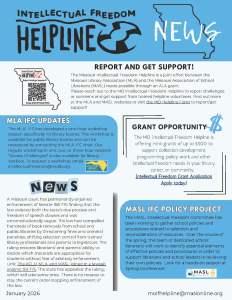
Missouri Intellectual Freedom Helpline
Please reach out to the MO Intellectual Freedom Helpline to report challenges or concerns and get support from trained helpline volunteers.
The Intellectual Freedom Committee (IFC) of the American Library Association (ALA)
Mission
American Library Association Office for Intellectual Freedom
Established December 1, 1967, the Office for Intellectual Freedom is charged with implementing ALA policies concerning the concept of intellectual freedom as embodied in the Library Bill of Rights, the Association’s basic policy on free access to libraries and library materials.
American Library Association Freedom to Read Foundation
The Freedom to Read Foundation was established in 1969 as a First Amendment legal defense organization affiliated with the American Library Association. FTRF is a separate corporation from the American Library Association, working in close liaison with the ALA. The secretariat is located in the Office for Intellectual Freedom, ALA Headquarters.